
Views: 0 Author: Site Editor Publish Time: 2026-03-10 Origin: Site


Jigsaw puzzles have made a remarkable comeback. What was once considered a quiet pastime for rainy afternoons has turned into a global hobby with dedicated communities, competitive events, and a booming market for jigsaw puzzles for sale. Whether you're assembling a compact 150-piece set or tackling a sprawling 2,000-piece masterpiece, the process can feel overwhelming without a clear strategy.
This guide walks you through everything you need to know—from choosing the right puzzle to placing that final satisfying piece. You'll also find practical tips for staying organized, avoiding common mistakes, and getting the most out of every session. By the end, you'll have a reliable system that makes puzzling faster, more enjoyable, and far less frustrating.
Before you start assembling, it helps to know what you're working with. Not all jigsaw puzzles are the same, and the material, piece count, and design all affect how you approach the build.
Type | Material | Best For | Typical Piece Count |
|---|---|---|---|
Blue Cardboard Puzzle | Blue cardboard | Kids, vibrant designs | 36–2,000 |
Grey Cardboard Puzzle | Grey cardboard | Adults, detailed art | 500–2,000 |
White Cardboard Puzzle | White cardboard | Classic puzzling | 150–2,000 |
Wooden Puzzle | Wood | Premium experience | 150–2,000 |
3D Jigsaw Puzzle | Plastic/wood | Sculptural builds | 36–1,000+ |
Irregular-Shaped Puzzle | Cardboard/wood | Unique challenge | 150–2,000 |
Blank Jigsaw Puzzle | Various | Custom/DIY art | 36–2,000 |
For beginners, a blue cardboard puzzle is a great starting point. The distinctive blue backing makes it easy to spot the front from the back of each piece, which speeds up the sorting process considerably.
If you're shopping for jigsaw puzzles for sale with a bit more flair, funny jigsaw puzzles—featuring playful artwork or quirky illustrations—are widely available and make the experience feel lighter and more social.
The right puzzle makes a real difference, especially for beginners. Choose one that's slightly challenging but not discouraging.
A good rule of thumb:
Beginners: 150–500 pieces with bold, high-contrast images
Intermediate puzzlers: 500–1,000 pieces with moderate image detail
Advanced puzzlers: 1,000–2,000+ pieces with complex patterns or gradients
Also consider the image. Scenes with clear sections of distinct colors—like a landscape with a bright sky, green fields, and a red barn—are much easier to work through than images with repetitive patterns or large monochromatic areas.
For something unique, a Van Gogh Starry Night frame puzzle is an excellent choice. At 150 pieces, it's approachable for most skill levels, and the bold swirling brushstrokes give you plenty of distinct sections to work with. It even comes with a wooden frame, so you can display the finished puzzle as wall art.
A well-organized workspace is half the battle. Here's how to set yourself up for success.
Use a flat, stable surface with enough room for both the assembled puzzle and your sorting piles. A dedicated puzzle mat is useful if you need to move the puzzle mid-progress—it rolls up without disrupting your work.
Turn every piece face-up before you do anything else. This simple step saves enormous amounts of time later. It's much easier to assess shape and color when you're not constantly flipping pieces over.
Sorting is the foundation of efficient puzzling. Most experienced puzzlers sort by:
Edge pieces: Flat-sided pieces form the border
Color or pattern: Group similar tones and textures together
Distinctive features: Faces, text, unusual shapes, or focal points
Use small bowls, trays, or the puzzle box lid to keep groups separated.
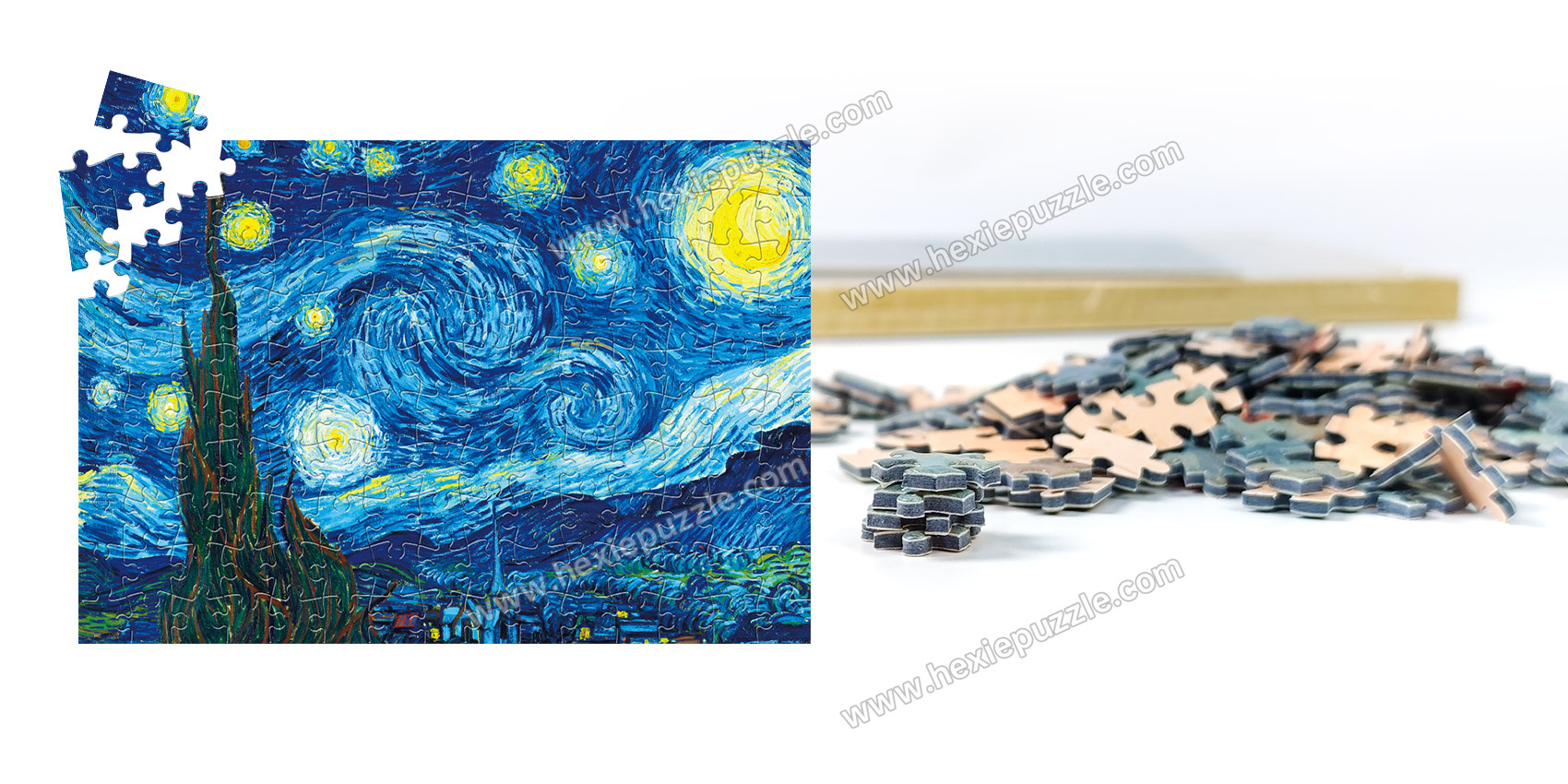
Once your pieces are sorted, you're ready to build. Follow these steps in order for the smoothest experience.
Connect all the edge pieces to form the frame of the puzzle. This gives you a defined boundary to work within and provides anchoring reference points as you fill in the middle.
Look at the reference image and identify the most visually distinct areas—a bright sky, a person's face, a logo, or a patch of contrasting color. Assemble these sections separately before connecting them to the border.
Puzzle pieces come in different shapes—some with two tabs and two blanks, others with three tabs or unusual curves. When color alone isn't helping, focus on shape. Two pieces that look nearly identical in color may have completely different connector profiles.
Once your border is complete and your distinct sections are assembled, start filling in the middle by connecting your completed clusters. Working outward from clear anchor points is more efficient than randomly testing pieces.
Save the trickiest areas—large patches of a single color, sky gradients, or repeating textures—for last. By then, you'll have fewer pieces to sort through, and the surrounding completed sections will narrow down placement options significantly.
Even seasoned puzzlers hit a wall somewhere around the middle. Here are a few strategies to keep the momentum going.
Set micro-goals: Instead of thinking about finishing the entire puzzle, aim to complete one section per session. Finishing a small cluster gives you a genuine sense of progress.
Puzzle with others: Funny jigsaw puzzles work especially well in social settings. The playful imagery sparks conversation, and two sets of eyes spot connections faster than one.
Take breaks: Puzzling with tired eyes leads to mistakes and frustration. Step away for 15–20 minutes and come back with a fresh perspective. You'll almost always spot something you missed.
Keep the reference image visible: Don't rely on memory. Prop up the box or place the reference sheet next to your workspace so you can check it quickly without breaking your flow.
It depends on the piece count, image complexity, and your experience level. A 150-piece puzzle might take 30–60 minutes for an adult. A 1,000-piece puzzle typically takes anywhere from 5 to 20 hours spread across multiple sessions.
Check the floor and underneath furniture first—pieces often slide off the table unnoticed. If a piece is genuinely missing from a new puzzle, contact the manufacturer. Reputable brands like HeXie Toys inspect their products before shipping and will typically address production issues promptly.
Both methods have their place, and most experienced puzzlers use both simultaneously. Color sorting is faster and more intuitive at the start. Shape sorting becomes more useful in the later stages when you're working through sections with limited color variation.
Apply puzzle glue to the front surface once complete. Let it dry flat, then flip and glue the back if you want extra durability. You can then frame and display it. Some puzzles—like the Van Gogh Starry Night frame set—come with a wooden frame included, making display effortless.
Funny jigsaw puzzles feature humorous or whimsical artwork—cartoon animals, absurd scenarios, pop culture references. Difficulty-wise, they're comparable to standard puzzles of the same piece count. The playful imagery often makes it easier to distinguish sections, though highly detailed funny illustrations can still pose a decent challenge.
The difference between a frustrating puzzle experience and an enjoyable one usually comes down to preparation. Sort your pieces thoroughly, build your border first, work section by section, and use your reference image liberally. These habits compound quickly—each puzzle you complete makes the next one faster and more satisfying.
Ready to put this into practice? Browse HeXie's full range of jigsaw puzzles for sale—from beginner-friendly blue cardboard puzzles to display-worthy framed sets like the Van Gogh Starry Night puzzle—and find the right challenge for your next session.


